
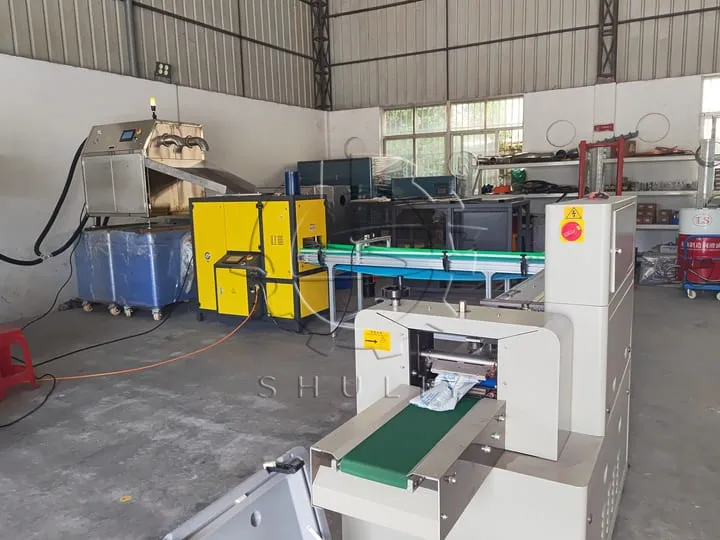
Starting a dry ice production plant requires more than a dry ice machine. You also need a reliable liquid CO₂ supply, suitable storage equipment, and a practical system for handling and packing the finished product.
At Shuliy, we offer dry ice production equipment for businesses planning to manufacture dry ice pellets or blocks. Below, we explain the main equipment you should consider before setting up your production plant.
1. Dry Ice Production Machine
The dry ice machine is the core equipment of your dry ice production plant. Your choice depends on the type of dry ice you plan to sell.
Dry ice pelletizer
A dry ice pellet making machine converts liquid CO₂ into solid pellets. Our dry ice pellet machines offer capacities of 50–500 kg/h, with pellet sizes ranging from 3 to 19 mm.
Pellets are commonly used for dry ice blasting, industrial cleaning, food cooling, and cold-chain transportation.
Dry ice block machine
If your customers need larger pieces of dry ice, a dry ice block machine is the more suitable choice. It compresses CO₂ snow into blocks of different sizes according to the machine configuration.
Block dry ice is often used for food preservation, refrigerated transportation, and other cooling applications.
Before purchasing, consider your target output, product dimensions, and the needs of your customers.
2. Liquid CO₂ Storage Tank
Liquid carbon dioxide is the raw material used to manufacture dry ice. Therefore, a stable CO₂ supply is essential for continuous production.
A liquid CO₂ storage tank stores the raw material and supplies it to the production machine. Tank capacity should match your machine’s output, daily operating hours, and the delivery schedule of your CO₂ supplier.
For example, a plant producing several hundred kilograms of dry ice per hour needs a suitable industrial supply system rather than relying on ordinary small gas cylinders.
If you already have a liquid CO₂ supply system, we can assess its compatibility with the selected dry ice machine before determining the equipment configuration.
3. CO₂ Supply Pipeline and Pressure Control System
The liquid CO₂ tank and dry ice machine must work together. Connecting equipment, insulated pipelines, and pressure-control components help deliver CO₂ under the operating conditions required by the machine.
When planning your dry ice production plant, pay attention to:
- Compatibility between the storage tank and production machine.
- Pipeline specifications and insulation.
- Required CO₂ inlet pressure and flow rate.
- Safe routing of exhaust gas.
These components should be selected and installed according to the machine manufacturer’s requirements and applicable local pressure-system regulations.
4. Dry Ice Storage Containers
Dry ice begins to sublimate as soon as it is produced, gradually changing from solid carbon dioxide into gas. Proper storage can slow this process and reduce product loss.
Insulated dry ice containers are useful for temporary storage, order preparation, and delivery.
The required number and capacity depend on your daily production, packaging method, and delivery schedule. If you mainly produce dry ice against customer orders, you may not need a large finished-product storage area.
5. Dry Ice Packaging Equipment
Packaging equipment is optional for some small plants but can be useful when supplying dry ice to multiple customers.
Depending on your products and sales model, you may need:
- Weighing equipment for different order sizes.
- Bagging and sealing equipment for dry ice pellets.
- Suitable packaging materials and insulated containers.
- Handling equipment for moving larger blocks.
For a small operation, manual weighing and packing may be sufficient. As order volumes increase, you can consider automated packaging to improve handling efficiency.
6. Ventilation and Safety Equipment
Safety planning is an essential part of setting up a dry ice production plant. Dry ice releases carbon dioxide gas during production, storage, and transportation. High CO₂ concentrations can create a serious asphyxiation hazard.
Your facility should include appropriate mechanical ventilation, carbon dioxide gas detectors, and alarm systems where required. The storage and production areas should be designed to prevent gas accumulation, especially in low-lying or enclosed spaces.
Operators also need suitable insulated gloves, eye protection, and training for handling extremely cold dry ice.
Consult qualified engineers and local authorities to determine the ventilation, pressure equipment, electrical, and occupational safety requirements for your site.
7. How to Choose the Right Dry Ice Production Plant Configuration
Not every business needs a fully automated production line. The best configuration depends on your planned capacity and the customers you intend to serve.
| Your business needs | Suggested configuration |
| Small-scale pellet production | Dry ice pelletizer, compatible CO₂ supply, storage containers |
| Dry ice block production | Dry ice block machine, CO₂ supply system, insulated storage |
| Pellet and block production | Separate machines or a suitable combined solution |
| Commercial production and distribution | Production equipment, appropriately sized CO₂ storage, packaging and handling equipment |
Remember that the CO₂ supply system must be sized for actual production demand. The production machine’s rated capacity alone does not determine the output of the entire dry ice production plant.
8. What Should You Prepare Before Purchasing?
Before selecting equipment, we recommend confirming the following details:
- Target capacity: How many kilograms of dry ice do you want to produce per hour?
- Product type: Do you need pellets, blocks, or both?
- Application: Will the dry ice be used for cleaning, food cooling, or cold-chain transportation?
- Raw material supply: Can you obtain liquid CO₂ locally, and how frequently can it be delivered?
- Factory conditions: What power supply, floor space, and installation conditions are available?
- Packaging requirements: Will you sell loose dry ice, bagged pellets, or packed blocks?
These details help us recommend a configuration that fits your actual production needs instead of including equipment you may not need.
Start Planning Your Dry Ice Production Plant
Choosing the right equipment is the first step toward establishing a dry ice production business. Whether you want to produce 50 kg/h of dry ice pellets or build a larger production facility, we can help you compare suitable machines and plan the main equipment configuration.
Contact Shuliy to discuss your dry ice production project. Tell us your target capacity, preferred product type, and application, and we will help you select suitable dry ice production equipment for your business.