
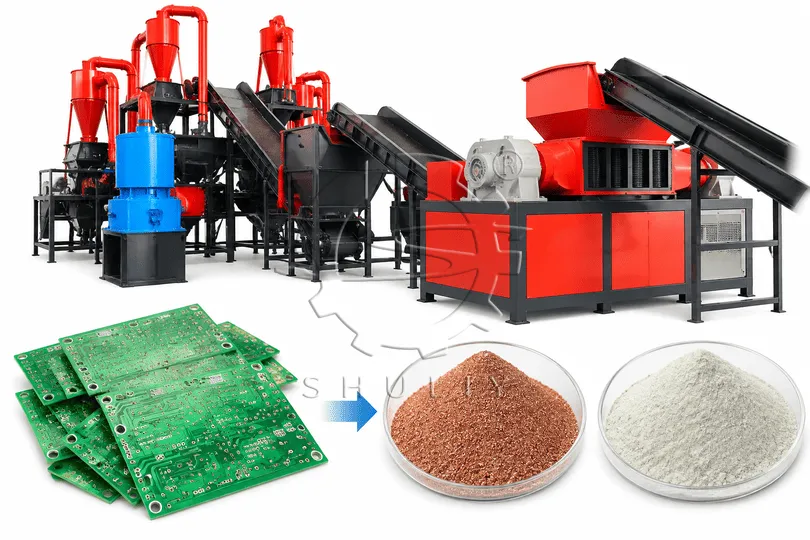
Наш PCB recycling machine is designed to process waste printed circuit boards (PCBs), copper-clad laminates (CCL), scrap circuit boards, and other electronic board materials. Through a series of shredding, crushing, grinding, and separation processes, the machine separates metal from non-metal materials, producing metal powder and non-metallic powder for further recovery and utilization.
We provide complete PCB recycling equipment with different processing capacities, ranging from 150 kg/h to 1,200 kg/h. The system integrates automatic feeding, multi-stage crushing, water-cooled grinding, air separation, electrostatic sorting, and dust collection to meet different waste circuit board recycling requirements.
What Materials Can the PCB Recycling Machine Process?
Our circuit board recycling machine is suitable for processing various types of waste circuit board materials, including:
- Waste Printed Circuit Boards: Discarded electronic circuit boards collected from electronic equipment.
- Copper-Clad Laminates (CCL): Scrap copper-clad boards used in circuit board manufacturing.
- Scrap Circuit Boards: Rejected circuit boards and production scraps.
- Electronic Board Waste: Various discarded electronic board materials containing metal and non-metal components.
These materials contain valuable metals as well as non-metallic components such as fiberglass and epoxy resin. The PCB recycling system processes them into powder and separates the two material fractions for further recovery.
How Does a PCB Recycling Machine Work?
Our PCB recycling machine adopts a multi-stage crushing and separation process. The complete system combines mechanical size reduction with air and electrostatic separation to recover metal powder from waste circuit boards.
The main processing steps are as follows:
1. Shredding – Primary Size Reduction
Waste circuit boards are first fed into the circuit board shredder. The machine tears large circuit boards into smaller pieces, preparing the materials for the next crushing stage.
This initial shredding process reduces the size of the raw materials and makes subsequent processing more convenient.
2. Hammer Crushing – Further Material Reduction
The shredded circuit board pieces enter the hammer crusher for further crushing.
The PCB crusher machine reduces the material size, allowing the smaller particles to enter the fine grinding stage. This multi-stage crushing arrangement helps process circuit boards more effectively than relying on a single crushing machine.
3. Water-Cooled Grinding – Fine Powder Production
After hammer crushing, the materials enter the water-cooled mill for further grinding.
The grinding machine is equipped with a rotary screening machine and uses a circulating water cooling system. Water cooling is applied inside and outside the grinding chamber to control the temperature during operation.
This stage converts the crushed circuit board materials into finer powder for subsequent separation.
4. Air Separation – Preliminary Metal Separation
The ground materials are then transferred to the air separator.
Through the separation process, the system separates the metal fraction from the non-metal fraction containing a small amount of residual metal powder.
This is the preliminary separation stage before further electrostatic sorting.
5. Electrostatic Sorting – Further Separation
The non-metal fraction containing a small amount of metal powder enters the electrostatic sorting machine.
The machine further separates the remaining metal powder from the non-metallic materials, improving the separation result.
After this stage, the system produces two main finished products: metal powder and non-metallic powder.
6. Dust Collection – Working Environment Control
The PCB recycling system is equipped with a negative-pressure feeding system and a pulse dust removal system.
These components collect dust generated during material processing and help reduce dust dispersion in the working environment.
Final Products of the PCB Recycling Machine
The PCB recycling process mainly produces two types of finished materials: metal powder and non-metallic powder.
1. Metal Powder
Metal powder is recovered from the metal components contained in waste circuit boards. Copper is one of the main valuable metals commonly found in these materials, although the actual metal composition depends on the raw circuit boards.
The recovered metal powder can be collected for further metal recovery and processing.
2. Non-Metallic Powder
Non-metallic powder mainly comes from the non-metal components of circuit boards. Its main materials include fiberglass and epoxy resin, along with other possible inorganic fillers.
After metal separation, this powder can be collected for further evaluation and potential utilization in suitable industrial applications.
The composition and quality of the final products depend on the raw materials and processing conditions.
Features of Our PCB Recycling Machine
PLC Automatic Control System
The complete PCB recycling line adopts PLC intelligent programming and automatic control, combined with a human-machine interface touchscreen.
This system coordinates the operation of different machines and helps maintain uniform material feeding throughout the production process.
Multi-Stage Crushing and Grinding
The production line integrates a shredder, hammer crusher, and water-cooled mill.
Different crushing stages gradually reduce the size of waste circuit boards before separation, making the system suitable for processing different types of scrap circuit board materials.
Water-Cooled Grinding System
The grinding section uses circulating water cooling inside and outside the crushing chamber.
This design helps control the temperature generated during grinding and supports continuous material processing.
Air and Electrostatic Separation
The system combines gravity-based separation and electrostatic sorting to separate metal and non-metal materials.
According to the equipment specifications, the metal recovery rate is at least 98%, while the equipment description states that it can reach over 99%. Actual recovery performance depends on the raw materials and operating conditions.
Negative-Pressure Feeding and Pulse Dust Collection
The PCB recycling machine uses a negative-pressure feeding system and pulse dust removal system to collect dust during processing and improve the working environment.
Compact Structure and Stable Operation
The complete equipment has a compact structure and reasonable layout. Noise reduction treatment is also applied to the crushing equipment to help reduce operating noise.
PCB Recycling Machine Technical Parameters
We offer four PCB recycling machine models to meet different processing capacity requirements.
| Модель | Власть | Емкость | Overall Dimensions | Масса |
|---|---|---|---|---|
| СЛ-1000 | 45 kW | 150–200 кг/ч | 6000 × 7500 × 4200 mm | 4,250 kg |
| СЛ-1500 | 68 kW | 200–300 кг/ч | 7000 × 8200 × 4500 mm | 6,500 kg |
| SL-1800 | 110 kW | 300–500 кг/ч | 8000 × 11000 × 4800 mm | 8,500 kg |
| SL-2000 | 198 kW | 1000–1200 kg/h | 8200 × 16000 × 5250 mm | 12,500 kg |
Additional specifications:
- Metal recovery rate: ≥98%
- Dust collection efficiency: ≥99%
The actual processing capacity depends on the type, size, and composition of the raw circuit boards.
Why Choose Our PCB Recycling Equipment?
Choosing the right PCB recycling equipment is important for obtaining a suitable processing capacity and separation result.
Our complete recycling system offers several advantages:
- Complete Processing System: Integrates shredding, hammer crushing, grinding, air separation, and electrostatic sorting.
- Different Capacity Options: Four models are available, with processing capacities from 150 kg/h to 1,200 kg/h.
- Automatic Operation: PLC control coordinates the operation of the entire production line.
- Effective Material Separation: Combines gravity-based separation and electrostatic sorting to recover metal powder.
- Dust Collection System: Negative-pressure feeding and pulse dust removal help control dust during production.
We can help you select a suitable PCB recycling machine according to your raw material type and required processing capacity.
Get a PCB Recycling Machine for Your Project
Are you planning to recycle waste printed circuit boards, copper-clad laminates, or scrap electronic boards?
Tell us about your raw materials, expected processing capacity, and production requirements. Our team can recommend a suitable PCB recycling machine model and complete processing configuration for your project.
Contact us for equipment details, technical specifications, and a customized quotation.